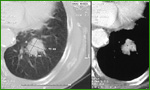
 Pre-treatment
computerized tomography |
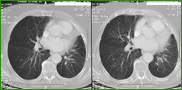 Post-treatment
computerized tomography |
 Recently,
with a variant of stereotactic radiotherapy, high doses of radiation
can be targeted at body areas other than the brain. This new technique
is called 'dynamic micro-multileaf stereotactic radiotherapy'. Recently,
with a variant of stereotactic radiotherapy, high doses of radiation
can be targeted at body areas other than the brain. This new technique
is called 'dynamic micro-multileaf stereotactic radiotherapy'.
It was difficult to apply the stereotactic technique to other areas
of the body because of various problems (e.g. breathing movements,
and the impossibility of applying high doses of radiation because
of radiosensitive organs near the target).
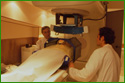 With
the micro-multileaf technique it is possible to irradiate volumes
up to 12 cm in diameter by 'customizing' the technique. Anatomic
structures that must not receive radiation are shielded by leafs
fitted on the linear accelerator. Once the gross tumor volume (GTV)
has been identified with CT and planning 3D, treatment can be targeted
on that volume plus a small surrounding area, thereby sparing healthy
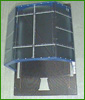
structures and tissue. To overcome the problem of reproducibility,
we use immobilization systems consisting of thermoplastic masks,
polyurethane body templates and a device in the treatment bunker,
called 'patient tracking system' whereby three TV cameras reproduce
on a monitor the position assumed by the patient during simulation
CT. With
the micro-multileaf technique it is possible to irradiate volumes
up to 12 cm in diameter by 'customizing' the technique. Anatomic
structures that must not receive radiation are shielded by leafs
fitted on the linear accelerator. Once the gross tumor volume (GTV)
has been identified with CT and planning 3D, treatment can be targeted
on that volume plus a small surrounding area, thereby sparing healthy
structures and tissue. To overcome the problem of reproducibility,
we use immobilization systems consisting of thermoplastic masks,
polyurethane body templates and a device in the treatment bunker,
called 'patient tracking system' whereby three TV cameras reproduce
on a monitor the position assumed by the patient during simulation
CT.
If necessary, the 'static' system can be transformed into the 'dynamic'
system. The leafs can move even during therapy, in synchrony with
the linear accelerator that moves in concentric arcs. Thus, we can
reduce the dose to volumes surrounding the GTV and to use even higher
doses in one or more sessions. 'Dynamic' radiotherapy is used to
treat single peripheral lung lesions, also metastatic, primary or
metastatic liver tumors, pancreatic tumors and practically anywhere
the tumor size is sufficiently small for treatment, which is administered
in the outpatient clinic.
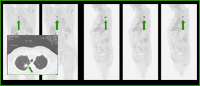 Before
Pet
Before
Pet |
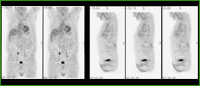 After
Pet
After
Pet |
|







