|
 Brachytherapy
involvers implanting a radioactive source into or near the tumor
for several minutes or hours depending on the equipment used. During
treatment the patient is isolated and controlled; at the end of
treatment, the patient is not radioactive and can, in most cases,
return home. For some kinds of tumors brachytherapy is associated
with external beam radiotherapy. Brachytherapy
involvers implanting a radioactive source into or near the tumor
for several minutes or hours depending on the equipment used. During
treatment the patient is isolated and controlled; at the end of
treatment, the patient is not radioactive and can, in most cases,
return home. For some kinds of tumors brachytherapy is associated
with external beam radiotherapy.
 The
treatment is accurate and flexible and the brachytherapy implant
precisely reflects the treatment plan given its short duration and
the external link to the 'applicator'. The
treatment is accurate and flexible and the brachytherapy implant
precisely reflects the treatment plan given its short duration and
the external link to the 'applicator'.
PERMANENT
IMPLANT
Brachytherapy in localized prostate cancer
'Permanent' brachytherapy involves implanting tiny 'seeds' that
contain radioactive palladium 103/Pd or iodine 125/I-125 in the
prostate gland. The procedure is minimally invasive is takes about
90 minutes to complete.
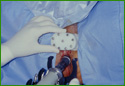
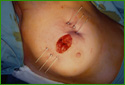
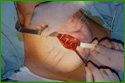
The seeds are contained in thin needles that are passed, under ecographic
guidance, into the prostate gland through the skin between the scrotum
and anus (perineum). This usually performed under sedation or local
anesthesia. The ecographic probe and the needles are extracted after
the procedure.
Each seed continuously releases a small amount of radiation to a
limited part of the prostatic tissue.
Consequently,
high doses of radiation can be directed at the tumor without damaging
the surrounding healthy tissue. The radioactivity of the seeds slowly
decays in the months after implantation, and can remain in position
without affecting the patient in any way.
The percent of cures in the first series patients with localized
prostate carcinoma treated12 years ago with this technique was similar
to that obtained with surgery (radical prostatectomy) and above
that obtained with conventional external beam radiotherapy.
Brachytherapy can be proposed as an alternative to radical prostatectomy
in patients affected by clinically localized prostate adenocarcinoma.
Depending on the patient's clinical, physical and psychological
characteristics, the physician will suggest the most appropriate
treatment (brachytherapy, surgery or other forms of treatment of
prostate cancer).
TEMPORARY
IMPLANT
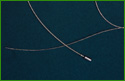 Also
'temporary' brachytherapy involves targeting high doses of radiation
to well-defined areas while sparing healthy surrounding tissue.
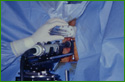
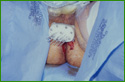
In this case, the radioactive source is implanted in the prostate
gland with thin catheters. The patient undergoes transrectal ultrasound
to determine the number and position of the catheters through which
the radioactive seeds will be implanted. The catheters are then
passed, under ecographic guidance, into the prostate gland through
the skin between the scrotum and anus (perineum), under sedation
or local anesthesia. When the seeds have been implanted, the patient
undergoes a treatment-planning prostate CT. Because the treatment
plan is decided after implantation, treatment can be optimized in
case of misplacement of catheters. At present, only HDR iridium-192
is used for temporary brachytherapy. Also
'temporary' brachytherapy involves targeting high doses of radiation
to well-defined areas while sparing healthy surrounding tissue.
In this case, the radioactive source is implanted in the prostate
gland with thin catheters. The patient undergoes transrectal ultrasound
to determine the number and position of the catheters through which
the radioactive seeds will be implanted. The catheters are then
passed, under ecographic guidance, into the prostate gland through
the skin between the scrotum and anus (perineum), under sedation
or local anesthesia. When the seeds have been implanted, the patient
undergoes a treatment-planning prostate CT. Because the treatment
plan is decided after implantation, treatment can be optimized in
case of misplacement of catheters. At present, only HDR iridium-192
is used for temporary brachytherapy.
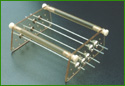 Radiation
treatment is administered in a shielded bunker to limit the operator's
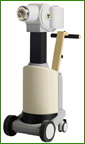
exposure to radiations. In the bunker, an afterloading device (teleloading
the radioactive sources) allows the insertion of the same seed (with
reduced costs) in the planned position, and the time it remains
is determined with dedicated software. The procedure can be done
in day surgery. The number of sessions varies from one to eight
at weekly intervals, and the procedure can be associated with a
cycle of external conformational radiotherapy. Radiation
treatment is administered in a shielded bunker to limit the operator's
exposure to radiations. In the bunker, an afterloading device (teleloading
the radioactive sources) allows the insertion of the same seed (with
reduced costs) in the planned position, and the time it remains
is determined with dedicated software. The procedure can be done
in day surgery. The number of sessions varies from one to eight
at weekly intervals, and the procedure can be associated with a
cycle of external conformational radiotherapy.
The higher energy of iridium-92 compared with radiation sources
used for permanent implants, provides a wider dosimetric cover,
which is desirable in the case of capsular micro-infiltrations.
|